Tag: How-to

  • Why Ads Don’t Show on Your Website (And How to Fix It)

    Why Ads Don’t Show on Your Website (And How to Fix It)

    If your website ads suddenly stopped appearing — or never showed up at all — you’re not alone. This is one of the most common problems publishers face, especially with platforms like Google AdSense and other ad networks.

    Sometimes the issue is simple. Other times it’s caused by policy restrictions, technical conflicts, or low-quality traffic. The good news is that most ad display issues can be fixed once you identify the root cause.

    1. Your Site Is Still Under Review

    Many ad networks manually or automatically review websites before serving ads. During this period, ad spaces will remain blank.

    • Common Signs: Ads show as empty containers, your dashboard reads “Getting ready” (common in Google AdSense), or ads appear randomly on a few pages but not others.
    • The Fix: Wait 24 to 72 hours post-approval. Keep publishing original content and avoid changing your site’s theme or critical plugins during active review windows. ( This sometimes takes 1-2 weeks specially if it’s your first time monetizing the site).

    2. Active Ad Blockers

    A massive portion of web traffic uses ad-blocking software, which strips out ad scripts before the page even finishes rendering.

    • The Impact: You see zero ads on your own device, revenue looks unusually low, and ads work fine for some visitors but fail for others.
    • How to Test: Open your site in an Incognito/Private window, temporarily disable desktop browser extensions, or test the URL on a mobile device using a standard browser. Common culprits include uBlock Origin, AdBlock Plus, and Brave Browser Shields.

    3. Broken or Incorrect Ad Code Placement

    A tiny syntax error or a bad copy-paste job during ad code installation will completely prevent ads from rendering.

    • Common Issues: Missing HTML closing tags (), dropping ad codes into unsupported sidebar widgets, or layout conflicts within your theme.
    • WordPress Specifics: Script optimization features in popular plugins frequently break ad delivery. Watch out for conflicts with:
      • Caching Plugins (e.g., WP Rocket, LiteSpeed Cache)
      • Minification Tools (combining CSS/JS)
      • Lazy-Load Plugins (delaying ad scripts until a user scrolls)
    • The Fix: Re-copy the clean code directly from your ad network dashboard. Turn off JavaScript optimization temporarily to see if the ads return.

    4. Policy Violations and Content Restrictions

    Ad networks protect their advertisers by limiting or disabling ad serving on pages that feature restricted or high-risk content.

    • High-Risk Content: Pages with copyrighted media, adult or shocking material, misleading download buttons, low-value/spammy AI-generated content, or heavy keyword stuffing.
    • The Fix: Even if your domain is fully approved, individual pages can be penalized. Check your ad network’s Policy Center regularly to clear any flagged URLs.

    5. Low Traffic or Poor Traffic Quality

    Networks prioritize advertiser budgets. If your traffic profiles look automated or low-value, ad networks will throttle your ad inventory.

    Quality over Quantity: Advertisers want human engagement. 100 highly engaged organic visitors are worth more than 10,000 automated views.

    • Avoid at all costs: Paid traffic farms, auto-refresh traffic exchanges, and click-incentive schemes.
    • The Fix: Focus on building clean, high-value traffic channels like organic Google search, natural social media shares, and returning direct readers.

    6. Privacy and Cookie Consent Plugins

    Strict privacy regulations (like GDPR and CCPA) mean that if a user rejects cookies—or if your setup is broken—ad scripts are completely blocked from initializing.

    • The Problem: If your cookie banner resets continuously or misconfigures script blocking, ads will never load for your visitors.
    • The Fix: Visit your site, manually accept the cookie prompts, and see if the ads appear. You can also use a VPN to test how your site handles consent across different global regions.

    7. Formatting Errors in Your ads.txt File

    An incorrect or missing ads.txt file signals to programmatic buyers that your ad inventory isn’t verified, causing advertiser demand to drop to zero instantly.

    • Common Mistakes: Typographical errors in your Publisher ID, duplicate entries, or missing authorized seller rows.
    • The Fix: Verify your file directly by navigating to yourdomain.com/ads.txt. Ensure the page loads publicly as plain text without redirecting or throwing formatting errors.

    8. Limited Inventory on New Domains

    Brand new websites and fresh domains face a natural “warm-up” period where ad networks evaluate the platform’s stability.

    • What Networks Evaluate: Historical site trust, content depth, user engagement metrics, and overall niche stability.
    • The Results: New sites frequently experience blank ad spaces, Public Service Announcement (PSA) ads, or exceptionally low Cost Per Mille (CPM) rates. Consistency in publishing matters far more here than constantly redesigning your layout.

    9. Aggressive Caching and CDN Conflicts

    Over-optimized site speed settings can accidentally cache the “blank” state of an ad or defer vital ad delivery scripts indefinitely.

    • Potential Causes: Features like Cloudflare Rocket Loader, HTML edge caching, and aggressive JavaScript deferral strategies.
    • The Fix: Clear your website plugin cache, flush your CDN (like Cloudflare), empty your local browser cache, and reload the page.

    10. Account-Level Ad Serving Limits

    Networks like Google AdSense frequently apply temporary ad serving limits if they detect patterns that mimic invalid click traffic.

    • Key Indicators: A sudden, steep drop in revenue overnight, highly inconsistent ad rendering, and account warning banners.
    • The Fix: This does not mean you are permanently banned. Address it by auditing your analytics for spam traffic, focusing heavily on content quality, and strictly avoiding accidental self-clicks during site development.

  • Getting your site monetized by Google AdSense

    Getting your site monetized by Google AdSense

    Here’s a general guide to help you through the process:

    1. Create Quality Content: Ensure your website has original, high-quality content that is useful and relevant to your audience. Aim for at least 20-30 posts or pages before applying.
    2. Comply with AdSense Policies: Familiarize yourself with Google AdSense policies and guidelines. Key areas include:
      • No adult content, violence, or illegal activities.
      • No misleading information or clickbait.
      • Ensure your content is family-friendly.
    3. Design a User-Friendly Website: Make sure your website has a clean and professional design. It should be easy to navigate, with clear menus and categories. Responsive design for mobile users is crucial.
    4. Add Essential Pages: Include important pages such as:
      • About Us
      • Contact Us
      • Privacy Policy
      • Terms and Conditions
    5. Ensure Your Site is Fully Functional: Check for broken links, slow loading times, and ensure that all features work properly.
    6. Set Up a Custom Domain: If possible, use a custom domain (e.g., www.yoursite.com) instead of a free subdomain.
    7. Check Traffic Sources: Ensure that your traffic comes from legitimate sources. Avoid using paid traffic services that violate AdSense policies.
    8. Apply for AdSense: Once your site is ready, go to the AdSense website and sign up. Fill out the application form and submit your site for review.
    9. Wait for Approval: Google will review your application, which can take anywhere from a few days to a couple of weeks. You’ll receive an email with the result of your application.
    10. Implement Ad Codes: If approved, you’ll receive ad code snippets to place on your website. Make sure to follow the instructions carefully to implement ads correctly.
    11. Monitor Performance: Once ads are live, monitor your performance and compliance with AdSense policies regularly to avoid issues.

    If your application is rejected, review the feedback provided, make the necessary changes, and consider reapplying after some time.

  • How to upload ads.txt file on your WordPress site

    How to upload ads.txt file on your WordPress site

    Adding an ads.txt file is typically required to get approval to monetize your website with ad networks.

    Here’s how you can upload an ads.txt file to your WordPress site:

    Method 1: Using an FTP Client

    1. Create Your ads.txt File:
      • Open a text editor (like Notepad or TextEdit).
      • Add the required lines to the file, specifying your ad network information.
      • Save the file as ads.txt.
    2. Connect to Your Website via FTP:
      • Use an FTP client (like FileZilla or Cyberduck) to connect to your web server.
      • Enter your FTP credentials (hostname, username, password, and port).
    3. Navigate to the Root Directory:
      • Once connected, navigate to the root directory of your WordPress installation, usually called public_html or the folder named after your domain.
    4. Upload the ads.txt File:
      • Drag and drop the ads.txt file from your computer into the root directory.
    5. Verify the Upload:
      • Open your browser and enter http://yourdomain.com/ads.txt to check if the file is accessible.

    Method 2: Using a File Manager in cPanel

    1. Create Your ads.txt File:
      • Follow the same steps as above to create and save the ads.txt file.
    2. Log into Your cPanel:
      • Access your hosting account and log into cPanel.
    3. Open File Manager:
      • Find and click on the File Manager icon.
    4. Navigate to the Root Directory:
      • Locate the root directory of your WordPress site (usually public_html).
    5. Upload the ads.txt File:
      • Click on the Upload button in the File Manager.
      • Select your ads.txt file and upload it.
    6. Verify the Upload:
      • As before, check by navigating to http://yourdomain.com/ads.txt in your browser.

    Method 3: Using a Plugin

    If you prefer a more user-friendly method, you can use a plugin:

    1. Install a Plugin:
      • Go to your WordPress dashboard.
      • Navigate to Plugins > Add New.
      • Search for a plugin like Ads.txt Manager or Insert Headers and Footers.
    2. Activate the Plugin:
      • Once installed, activate the plugin.
    3. Configure the Plugin:
      • Follow the plugin instructions to upload or enter the content for your ads.txt file.
    4. Save and Verify:
      • Save the changes and verify the upload by checking http://yourdomain.com/ads.txt.

    Final Steps

    Regardless of the method you choose, always remember to verify that the ads.txt file is accessible. This is essential for ad networks to recognize and validate your site.

  • Checking Site’s Core Web Vitals

    Checking Site’s Core Web Vitals

    Checking a website’s Core Web Vitals is essential for assessing its performance and user experience. Core Web Vitals focus on three main aspects: loading performance, interactivity, and visual stability.Here are several methods to check your site’s Core Web Vitals:

    1. Google PageSpeed Insights

    • Access the Tool: Go to PageSpeed Insights.
    • Enter URL: Type in the URL of the website you want to analyze.
    • Run Analysis: Click the “Analyze” button.
    • Review Results: The tool will provide a score for mobile and desktop performance, along with specific metrics for:
      • Largest Contentful Paint (LCP): Measures loading performance.
      • First Input Delay (FID): Measures interactivity.
      • Cumulative Layout Shift (CLS): Measures visual stability.

    2. Google Search Console

    • Access Google Search Console: Log into your Google Search Console account.
    • Select Your Property: Choose the website you want to analyze.
    • Navigate to Core Web Vitals: In the left sidebar, click on “Core Web Vitals” under the “Experience” section.
    • Review Report: You’ll see a report that shows how your site performs based on real user data, categorizing pages as “Good,” “Needs Improvement,” or “Poor.”

    3. Lighthouse

    • Open Chrome DevTools: Right-click on your website and select Inspect or press Ctrl + Shift + I (Windows) or Command + Option + I (Mac).
    • Navigate to Lighthouse: Click on the Lighthouse tab in the DevTools panel.
    • Generate Report: Select the options for mobile or desktop and click the “Generate Report” button.
    • Analyze Results: The report will include Core Web Vitals metrics along with recommendations for improvement.

    4. Web Vitals Chrome Extension

    • Install the Extension: Go to the Chrome Web Store and search for Web Vitals. Install the extension.
    • Run the Extension: After installation, click the extension icon while visiting your website.
    • View Metrics: The extension will display real-time metrics for LCP, FID, and CLS directly in your browser.

    5. GTmetrix

    • Access GTmetrix: Go to GTmetrix.
    • Enter URL: Type in the website URL you want to check.
    • Run the Analysis: Click the “Test your site” button.
    • Review Results: The report will provide a performance score along with recommendations, including Core Web Vitals metrics.

    6. WebPageTest

    • Access WebPageTest: Go to WebPageTest.
    • Enter URL: Input the URL of your website.
    • Select Test Options: Choose a location and browser, then click “Start Test.”
    • Analyze Results: Once the test completes, you’ll see detailed metrics, including Core Web Vitals.

    Final Steps

    After analyzing your Core Web Vitals, review the provided recommendations for improvement. Focus on optimizing loading times, enhancing interactivity, and ensuring a stable layout to enhance user experience and improve search rankings.

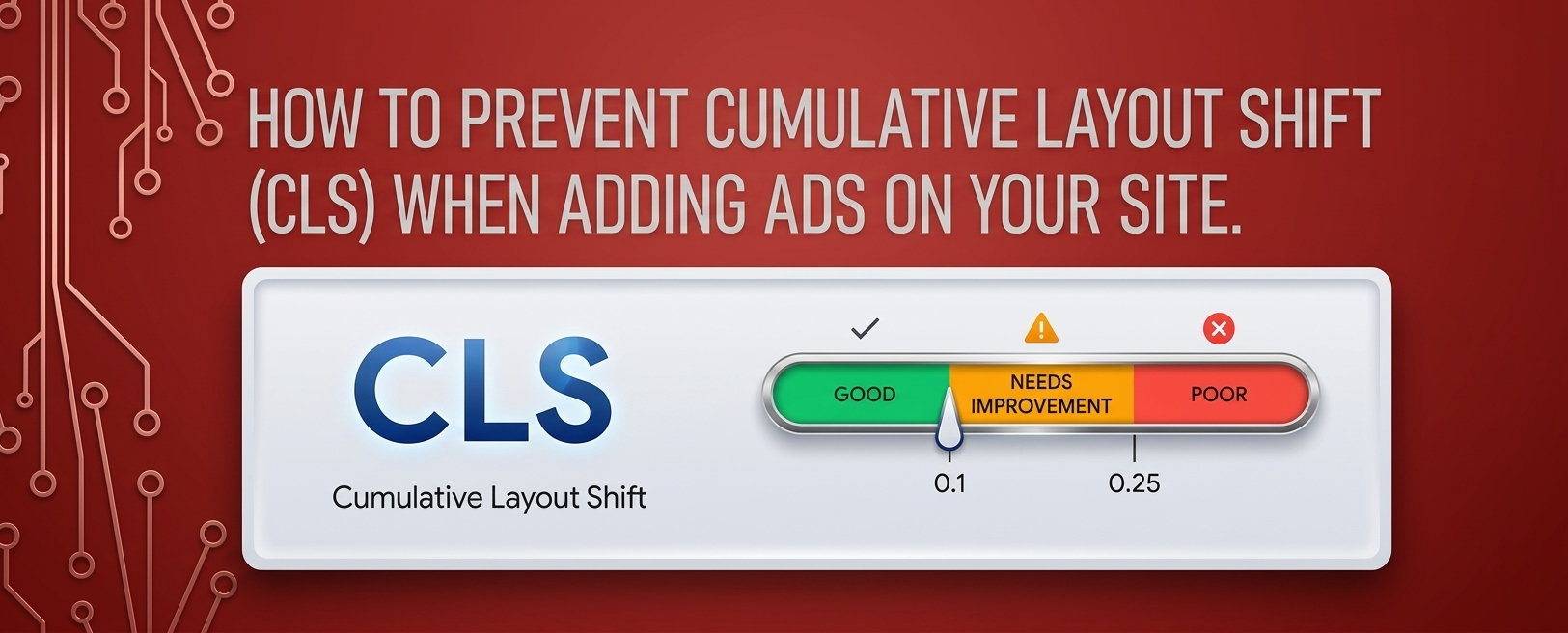
  • How to prevent Cumulative Layout Shift (CLS) when adding Ads on your site.

    How to prevent Cumulative Layout Shift (CLS) when adding Ads on your site.

    To prevent ads from causing layout shifts on your site, it’s important to implement best practices for ad placement and sizing. Here are some effective strategies:

    1. Specify Size for Ad Containers

    • Always define the width and height of your ad units in pixels or percentages. This ensures the browser reserves space for the ad before it loads.
    <div class="ad-container" style="width: 300px; height: 250px;">
    <script>/* Ad code here */</script>
    </div>

    2. Use Responsive Ads Carefully

    • If using responsive ad units, ensure the parent container has a defined aspect ratio. This helps maintain layout integrity during loading.
    .responsive-ad {
    width: 100%; /* Full width */
    height: auto; /* Maintain aspect ratio */
    padding-bottom: 75%; /* Example aspect ratio for 300x250 */
    position: relative; /* Position relative for absolute child */
    }

    3. Implement a Placeholder for Ads

    • Create a placeholder or a “dummy” ad container with fixed dimensions. This helps prevent layout shifts while the ad loads.
    code<div class="ad-placeholder" style="width: 300px; height: 250px;">
    <!-- Placeholder content -->
    </div>

    4. Reserve Space for Ads in CSS

    • Use CSS to ensure there’s a reserved space for the ad. This can be particularly useful for dynamic ads where the size might vary.
    code.ad-space {
    width: 300px; /* Fixed width */
    height: 250px; /* Fixed height */
    overflow: hidden; /* Hide overflow */
    }

    5. Load Ads Asynchronously

    • Load ads asynchronously to prevent them from blocking the rendering of other content. This can improve the overall loading experience.
    <script async src="https://your-ad-script.js"></script>

    6. Use Lazy Loading for Ads

    • Consider lazy loading ads that are off-screen. This can help manage loading times and prevent layout shifts for ads that aren’t immediately visible to the user.
    code<div class="lazy-ad" data-src="your-ad-code">
    <!-- Lazy loading logic -->
    </div>

    7. Minimize the Use of Pop-Up Ads

    • Avoid using pop-up ads that cover the main content and cause shifts when they appear. Instead, consider using static banners that fit within the layout.

    8. Test Your Ads Setup

    • After implementing your ads, use tools like Google PageSpeed Insights or Lighthouse to check your CLS score and see if the ads are causing any layout shifts.

    9. Regularly Update Ad Sizes

    • Stay updated with the latest ad sizes recommended by ad networks and make sure your site accommodates these dimensions properly.

    Conclusion

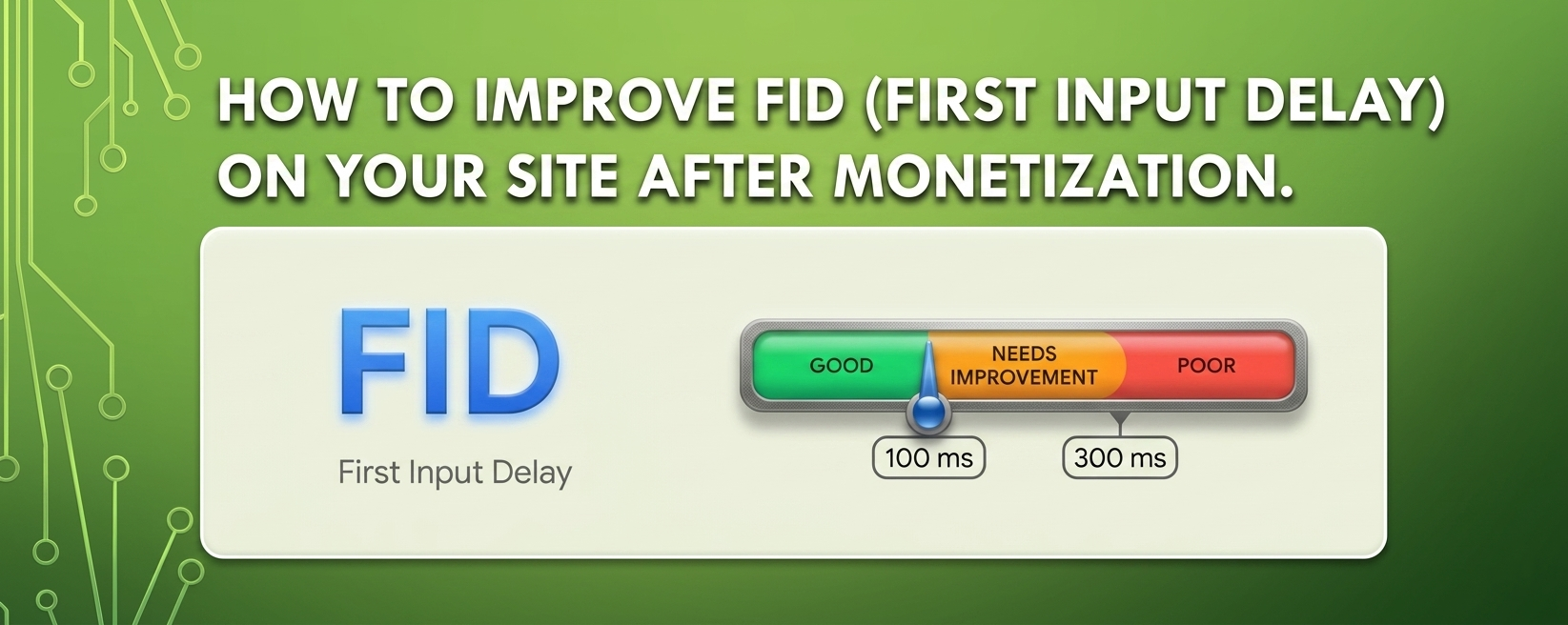
  • How to improve FID on your site after monetization.

    How to improve FID on your site after monetization.

    Improving First Input Delay (FID) on your site after monetization is crucial for maintaining a good user experience. FID measures the time it takes for a page to respond to a user’s first interaction (like clicking a link or button). Here are several strategies to enhance FID while ensuring your monetization efforts do not negatively impact performance:

    1. Optimize JavaScript Execution

    • Minimize JavaScript: Reduce the amount of JavaScript that needs to load before the page becomes interactive. Remove any unused code and minimize scripts where possible.
    • Defer and Async Loading: Use defer or async attributes on your script tags to prevent blocking the main thread. This allows the browser to load JavaScript without delaying the page’s initial rendering.
    htmlCopy code<script src="your-script.js" defer></script>
    

    2. Prioritize Critical Scripts

    • Load essential scripts for initial interactions first. Non-essential scripts can be loaded later, after the main content has loaded.

    3. Optimize Third-Party Scripts

    • Be mindful of third-party scripts, especially ads and tracking scripts, as they can slow down FID. Use lightweight alternatives or load them asynchronously.
    • Consider using a tag manager to control when and how third-party scripts are loaded.

    4. Reduce Main Thread Work

    • Limit the complexity of tasks running on the main thread during the page’s initial load. Break up long tasks using techniques like requestIdleCallback to improve responsiveness.

    5. Implement Lazy Loading

    • Use lazy loading for images and iframes to defer loading of off-screen content. This reduces the initial load time and allows users to interact with the page sooner.
    htmlCopy code<img src="example.jpg" loading="lazy" alt="Example">
    

    6. Optimize Your Web Fonts

    • Load fonts efficiently by using font-display: swap; in your CSS to ensure text remains visible during font loading. This prevents delays in rendering text and improves FID.
    cssCopy code@font-face {
        font-family: 'MyFont';
        src: url('myfont.woff2') format('woff2');
        font-display: swap;
    }
    

    7. Improve Server Response Times

    • Optimize your server response time to ensure that the HTML is delivered to the browser quickly. This includes optimizing your hosting environment and using caching strategies.

    8. Reduce Resource Size

    • Compress resources (images, CSS, and JavaScript) using tools like Gzip or Brotli. Smaller resource sizes reduce load times and improve responsiveness.

    9. Use a Content Delivery Network (CDN)

    • Implement a CDN to serve your content from locations closer to your users, reducing latency and improving load times.

    10. Monitor Performance Regularly

    Use tools like Google PageSpeed Insights, Lighthouse, or WebPageTest to regularly monitor your site’s performance, focusing on FID. Adjust strategies based on the data you collect.

  • Tips on how to improve LCP on your site after monetization

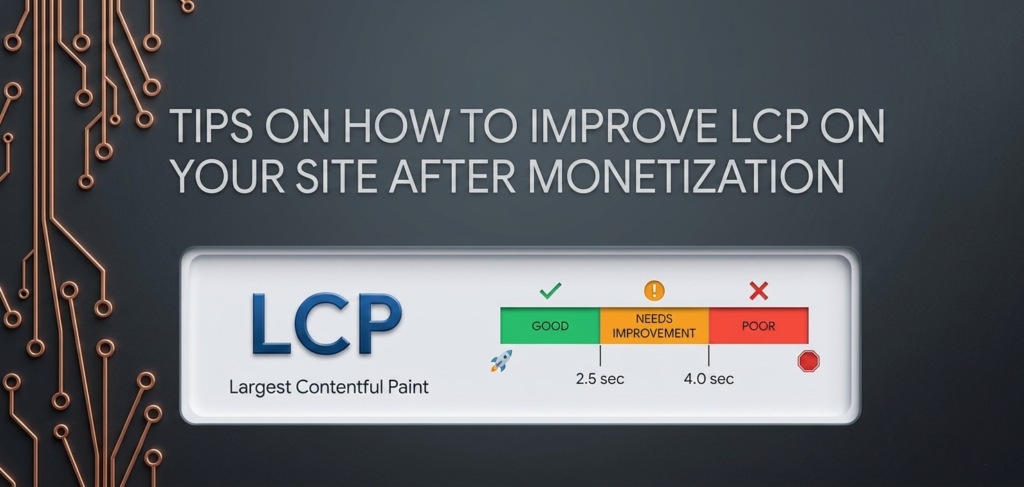
    Tips on how to improve LCP on your site after monetization

    Improving Largest Contentful Paint (LCP) on your site after monetization is essential for ensuring a positive user experience. LCP measures how quickly the largest visible content element on your page loads and is fully rendered. A good LCP score is under 2.5 seconds. Here are several strategies to enhance LCP while managing your monetization efforts:

    1. Optimize Images and Media

    • Use Appropriate Formats: Use modern image formats like WebP or AVIF, which offer better compression without compromising quality.
    • Compress Images: Optimize images to reduce file sizes. Use tools like TinyPNG or ImageOptim to compress images without significant loss in quality.
    • Specify Dimensions: Always specify the width and height attributes in your image tags or CSS. This helps the browser allocate space for images before they load.
    htmlCopy code<img src="example.webp" alt="Example" width="800" height="600">
    

    2. Improve Server Response Times

    • Optimize your server and hosting environment to ensure fast response times. This may involve choosing a better hosting plan or provider, optimizing your database, or using server-side caching.

    3. Use a Content Delivery Network (CDN)

    • Implement a CDN to serve static assets (like images, CSS, and JavaScript) from locations closer to your users. This reduces latency and speeds up content delivery.

    4. Minimize Render-Blocking Resources

    • Defer Non-Critical JavaScript: Use the defer or async attributes for script tags to prevent them from blocking rendering of the main content.
    • Inline Critical CSS: Inline critical CSS needed for rendering the above-the-fold content and load non-critical CSS asynchronously.

    5. Optimize Fonts

    • Load web fonts efficiently by using the font-display: swap; property in your CSS. This ensures text is visible while fonts are loading, preventing delays in rendering.
    cssCopy code@font-face {
        font-family: 'MyFont';
        src: url('myfont.woff2') format('woff2');
        font-display: swap;
    }
    

    6. Eliminate Unnecessary Plugins and Scripts

    • Review your site’s plugins and scripts, especially third-party ones like ads and tracking scripts. Remove any that are unnecessary, as they can slow down your site.

    7. Lazy Load Off-Screen Content

    • Implement lazy loading for images and iframes that are off-screen to reduce the initial load time for above-the-fold content.
    htmlCopy code<img src="example.jpg" loading="lazy" alt="Example">
    

    8. Optimize Your CSS

    • Minimize and compress CSS files to reduce their size and improve loading times. Combine CSS files where possible to reduce the number of HTTP requests.

    9. Reduce the Size of Your HTML

    • Optimize your HTML structure to reduce its size. Remove unnecessary comments and whitespace, and ensure that only essential elements are loaded initially.

    10. Monitor and Test Regularly

    Use tools like Google PageSpeed Insights, Lighthouse, or WebPageTest to monitor your LCP score and identify areas for improvement. Make adjustments based on the insights gained from these tools.

  • How to Use AI for Smarter Ad Placements: A Beginner’s Guide

    How to Use AI for Smarter Ad Placements: A Beginner’s Guide

    How to Use AI for Smarter Ad Placements: A Beginner’s Guide

    In the modern digital landscape, running ads without data is essentially “spraying and praying”—and that’s an expensive way to fail.

    The good news? You don’t have to be a data scientist to win. AI-powered tools within Google Ads and Meta Ads Manager now do the heavy lifting for you, automating the “where, when, and who” of your campaigns. This guide will show you how to leverage AI to stop wasting your budget and start reaching the right people.


    🤖 What Exactly Does AI Do for Your Ads?

    Think of AI as a 24/7 marketing assistant that never sleeps. It processes millions of data points in milliseconds—something no human could ever do manually.

    AI analyzes:

    • User Behavior: Who is clicking, scrolling, or watching?
    • Contextual Data: What device are they on? Where are they located?
    • Timing: When is a user most likely to make a purchase?

    The Shift: Instead of you guessing which website or app your customer visits, the AI identifies the intent and places your ad exactly where that person is at that moment.


    🎯 3 Ways to Leverage AI Right Now

    1. Smart Audience Targeting

    AI doesn’t just look at demographics; it looks at patterns. It finds “Lookalike Audiences”—people who behave exactly like your existing customers but haven’t discovered you yet.

    • Try this: Use Meta’s Lookalike Audiences or Google’s Predictive Segments.

    2. Automated Placement (The “Set It and Forget It” Advantage)

    Instead of manually picking “Instagram Stories” or “YouTube Sidebar,” let the machine decide.

    • The Tool: Meta Advantage+ Placements or Google Performance Max.
    • The Result: Your ad automatically shifts to whichever sub-platform is currently delivering the cheapest conversions.

    3. Real-Time Budget Optimization

    AI monitors which ads are winning and moves your money there instantly.

    • The Tool: Campaign Budget Optimization (CBO).
    • The Result: You stop spending money on “dud” ads and double down on winners without lifting a finger.

    🚀 Your 5-Step AI Starter Strategy

    If you’re ready to start, follow this “Low-Stress” workflow:

    1. Choose One Arena: Don’t be everywhere at once. Start with either Meta (Social) or Google (Search/Video).
    2. Trust the Algorithm: When setting up your campaign, select “Automatic Placements.” 3. Go Broad: Avoid hyper-niche targeting. Give the AI a larger pool of people so it has enough data to learn.
    3. The “Power of 3”: Upload at least 3 different images or videos. AI needs options to test which one resonates.
    4. The 7-Day Rule: Do not touch your ads for at least 5–7 days. This is the “Learning Phase” where the AI is calibrating.


    ⚠️ Mistakes That Kill AI Performance

    The Mistake
                                            Why it Hurts
    Micro-ManagingChanging settings every 24 hours resets the AI’s “learning” process.
    Over-TargetingAdding too many filters (age + interest + location + behavior) suffocates the AI.
    Bad CreativeAI can find the right person, but it can’t make a boring ad interesting.

  • How to Fix Low Fill Rate in Google Ad Manager (GAM)

    How to Fix Low Fill Rate in Google Ad Manager (GAM)

    How to Fix Low Fill Rate in Google Ad Manager (GAM)

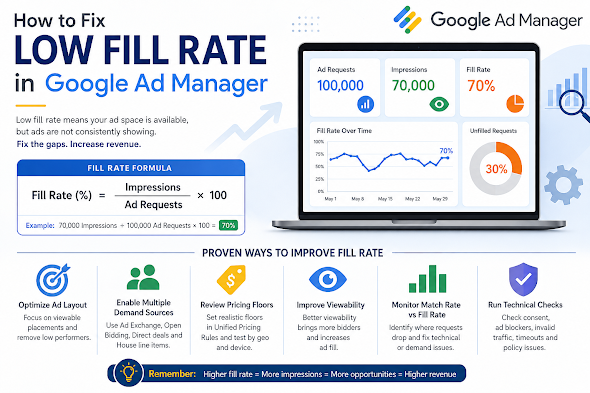
    If your revenue drops despite steady traffic, the first metric to audit is your Fill Rate. A low fill rate indicates that your site is generating ad requests that aren’t converting into impressions. Essentially, you are leaving money on the table.

    What Is Fill Rate?

    Fill rate is the percentage of ad requests that result in a displayed ad.

    Example: If you have 100,000 ad requests but only 70,000 impressions, your fill rate is 70%. While “healthy” rates vary by niche, most publishers aim for 80–95% on standard display inventory.


    5 Common Culprits Behind Low Fill Rate

    ReasonThe Impact
    Low Geo DemandTraffic from Tier 3 countries often lacks the advertiser depth to fill every request.
    Ad Unit OverloadToo many ad units on one page dilute bid competition and slow down page rendering.
    Restrictive SizesUsing non-standard sizes (e.g., 200×200) limits the pool of available creative assets.
    Aggressive FloorsSetting CPM floors too high rejects bids that would otherwise have filled the slot.
    Technical LatencyIf the page loads too slowly, the user may scroll past or leave before the ad renders.

    Strategic Solutions to Boost Fill

    1. Optimize Pricing Rules (UPRs)

    Check your Unified Pricing Rules in GAM. If your floors are set based on peak seasonal demand (like Q4), they may be too high for slower periods.

    • Action: Experiment with “Floor Shifting.” Lower floors for specific low-demand geographies or devices to capture “long-tail” revenue.

    2. Diversify Your Demand Stack

    Don’t put all your eggs in the AdSense/AdX basket. High-growth publishers use a multi-layered approach:

    • Header Bidding: Bring in Prebid.js to force AdX to compete with external SSPs.
    • Open Bidding: Enable Google’s server-to-server demand.
    • Backfill/House Ads: Ensure you have a “catch-all” line item (like a self-promotion or a low-priority ad network) to ensure 0% of requests go to waste.

    3. Focus on “Signal” over “Volume”

    Advertisers bid more—and more often—on high-viewability inventory.

    • Lazy Loading: Only request the ad when the user is about to scroll to it. This reduces “unfilled” requests from the bottom of the page that never get seen.
    • Ad Refresh: If using auto-refresh, ensure it only triggers when the ad is in view.

    4. Standardize Ad Sizes

    Enable Multi-Size Pricing. Instead of just requesting a 300×250, allow the slot to accept 300×600 or 320×50. Increasing the number of eligible creatives for a single slot naturally drives up the fill rate.


    Technical Troubleshooting Checklist

    If your demand looks healthy but fill is still low, check for these “silent killers”:

    • CMP Issues: If your Consent Management Platform isn’t firing correctly, Google cannot serve personalized ads (or any ads) in regulated regions like the EU (GDPR).
    • app-ads.txt / ads.txt: Ensure your file is reachable and up to date. Missing entries will lead to immediate bid rejection.
    • Mismatched Line Items: Check if your line item targeting (Geo, Device, Key-values) is too narrow for the traffic you are receiving.
    • Rendering Timeouts: If your Header Bidding timeout is too short, the auction might close before bids arrive.


    Summary: When Should You Worry?

    A temporary dip during the start of a quarter (January, April, July, October) is normal as advertiser budgets reset. However, a sustained drop usually points to a pricing mismatch or a technical bottleneck.

    The Goal: Optimization isn’t about adding more ads; it’s about making your existing ad slots more “eligible” for the highest number of buyers possible.

  • How to Add Ad Units in Google Ad Manager (GAM) for Beginners

    How to Add Ad Units in Google Ad Manager (GAM) for Beginners

    How to Add Ad Units in Google Ad Manager (GAM) for Beginners

    If you’re just starting with Google Ad Manager, one of the first things you need to understand is Ad Units.

    Ad Units are the spaces on your website where ads appear. Think of them as “containers” that tell Google Ad Manager exactly where an advertisement should be displayed — like the header, sidebar, in-article section, or footer.

    Without properly created Ad Units, GAM cannot serve ads correctly.

    This beginner-friendly guide walks you through the entire process step by step.


    What Are Ad Units in Google Ad Manager?

    An Ad Unit is a defined ad placement inside your website or app.

    Examples include:

    • Homepage banner
    • Sidebar rectangle
    • Sticky footer ad
    • In-article ad
    • Mobile anchor ad

    Each Ad Unit has:

    • A unique name
    • A unique code
    • Supported ad sizes
    • Targeting settings

    These are later connected to:

    • Line items
    • Orders
    • AdSense or Ad Exchange demand
    • Header bidding partners

    Why Proper Ad Unit Setup Matters

    A clean Ad Unit structure helps with:

    • Better reporting
    • Easier troubleshooting
    • Improved targeting
    • Higher CPM optimization
    • Cleaner header bidding integration
    • Better inventory organization

    Poorly organized ad units can create confusion later when your site scales.


    Before You Start

    You need:

    • A working Google Ad Manager account
    • Access to your website code or CMS
    • Basic understanding of where ads will appear on your site

    Step-by-Step: How to Add Ad Units in GAM

    Step 1: Login to Google Ad Manager

    Go to:

    Google Ad Manager

    After logging in:

    • Open the left sidebar
    • Click Inventory
    • Select Ad Units

    Step 2: Click “New Ad Unit”

    Inside the Ad Units page:

    • Click the New Ad Unit button
    • A setup page will appear

    This is where you define your ad placement.


    Step 3: Enter Ad Unit Details

    Ad Unit Name

    Use descriptive names.

    Good examples:

    • Homepage_Top_Leaderboard
    • Article_InContent_1
    • Sidebar_Rectangle
    • Mobile_Sticky

    Avoid random names like:

    • Ad1
    • BannerTest
    • Unit123

    Ad Unit Code

    This is automatically generated but can usually be customized.

    Keep it:

    • Short
    • Clean
    • Consistent

    Example:

    homepage_top
    article_mid_1
    sidebar_300x250

    Step 4: Select Ad Sizes

    Choose the ad sizes allowed in this placement.

    Common desktop sizes:

    • 728×90
    • 300×250
    • 336×280
    • 160×600

    Common mobile sizes:

    • 320×50
    • 300×250
    • 320×100

    You can:

    • Add multiple sizes
    • Use responsive sizes
    • Enable fluid/native formats

    Example:

    300x250, 336x280

    Step 5: Configure Target Window

    You’ll usually see:

    • Top Frame
    • SafeFrame
    • Friendly iframe

    For beginners, the default setting is generally fine.


    Step 6: Save the Ad Unit

    Click:

    Save

    Your new Ad Unit is now created.


    How to Generate the GAM Ad Tag

    After saving:

    1. Select the Ad Unit
    2. Click Generate Tags
    3. Choose:
      • Google Publisher Tag (GPT)
      • Single Request Architecture (recommended)

    GAM will generate JavaScript code.

    Example:

    <div id='div-gpt-ad-123456'></div>
    <script>
    googletag.display('div-gpt-ad-123456');
    </script>

    You’ll place this code on your website where you want ads to appear.


    Recommended Ad Unit Naming Structure

    As your site grows, organization becomes important.

    A good format is:

    Site_Section_Position_Size

    Example:

    Blog_Header_728x90
    Article_Mid_300x250
    Mobile_Footer_320x50

    This makes reporting much easier later.


    Best Practices for Beginners

    1. Keep Naming Consistent

    Consistency prevents confusion when managing hundreds of placements later.


    2. Avoid Too Many Sizes

    Too many ad sizes can:

    • Slow auctions
    • Reduce bid competition
    • Cause layout shifts

    Stick to high-performing standard sizes first.


    3. Separate Desktop and Mobile

    Desktop and mobile behavior are very different.

    Create dedicated units like:

    Desktop_Top
    Mobile_Top

    instead of mixing everything together.


    4. Use Responsive Design Carefully

    Responsive ads are useful, but incorrect implementation can break layouts.

    Test thoroughly on:

    • Desktop
    • Tablet
    • Mobile

    5. Plan for Future Growth

    Even if your site is small now, structure inventory properly from the start.

    This becomes critical when adding:

    Direct campaigns

    Ad Exchange

    Open Bidding

    Header bidding