Author: Squee

  • How to improve FID on your site after monetization.

    How to improve FID on your site after monetization.

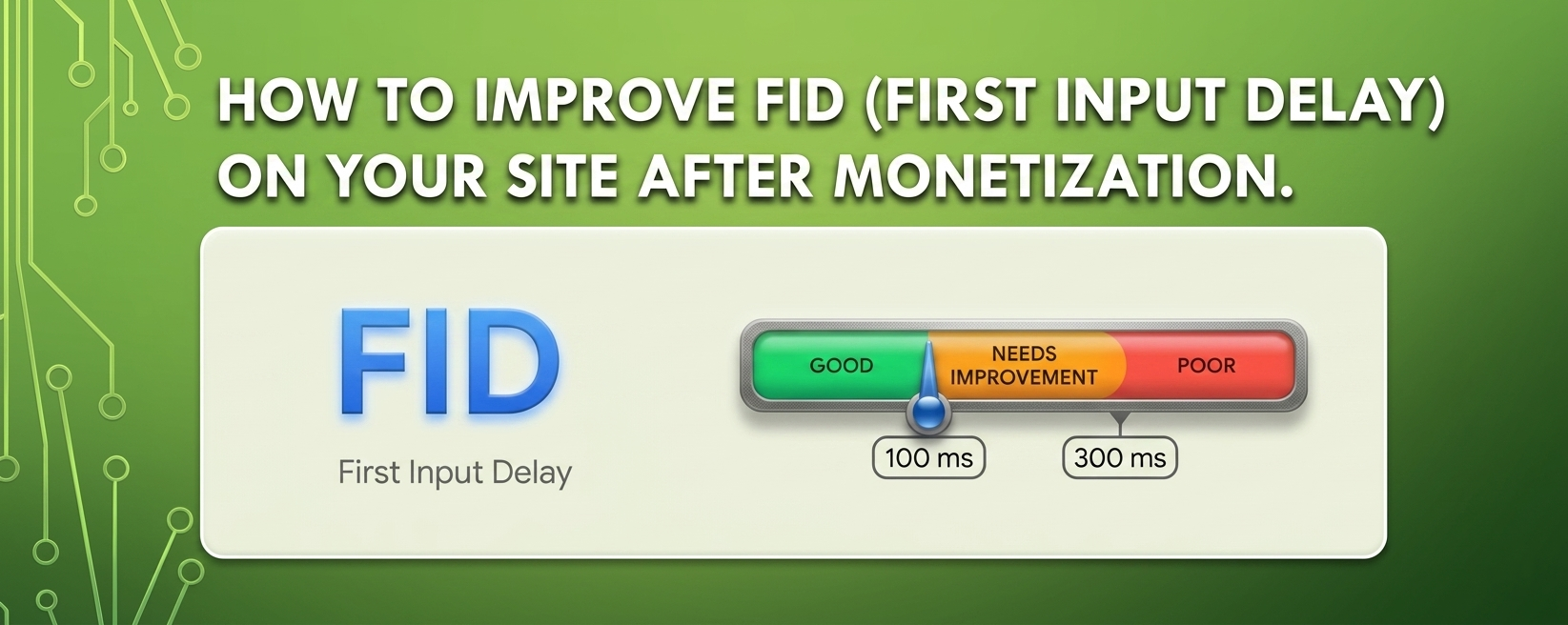
    Improving First Input Delay (FID) on your site after monetization is crucial for maintaining a good user experience. FID measures the time it takes for a page to respond to a user’s first interaction (like clicking a link or button). Here are several strategies to enhance FID while ensuring your monetization efforts do not negatively impact performance:
    1. Optimize JavaScript Execution

    • Minimize JavaScript: Reduce the amount of JavaScript that needs to load before the page becomes interactive. Remove any unused code and minimize scripts where possible.
    • Defer and Async Loading: Use defer or async attributes on your script tags to prevent blocking the main thread. This allows the browser to load JavaScript without delaying the page’s initial rendering.
    htmlCopy code<script src="your-script.js" defer></script>
    

    2. Prioritize Critical Scripts

    • Load essential scripts for initial interactions first. Non-essential scripts can be loaded later, after the main content has loaded.

    3. Optimize Third-Party Scripts

    • Be mindful of third-party scripts, especially ads and tracking scripts, as they can slow down FID. Use lightweight alternatives or load them asynchronously.
    • Consider using a tag manager to control when and how third-party scripts are loaded.

    4. Reduce Main Thread Work

    • Limit the complexity of tasks running on the main thread during the page’s initial load. Break up long tasks using techniques like requestIdleCallback to improve responsiveness.

    5. Implement Lazy Loading

    • Use lazy loading for images and iframes to defer loading of off-screen content. This reduces the initial load time and allows users to interact with the page sooner.
    htmlCopy code<img src="example.jpg" loading="lazy" alt="Example">
    

    6. Optimize Your Web Fonts

    • Load fonts efficiently by using font-display: swap; in your CSS to ensure text remains visible during font loading. This prevents delays in rendering text and improves FID.
    cssCopy code@font-face {
        font-family: 'MyFont';
        src: url('myfont.woff2') format('woff2');
        font-display: swap;
    }
    

    7. Improve Server Response Times

    • Optimize your server response time to ensure that the HTML is delivered to the browser quickly. This includes optimizing your hosting environment and using caching strategies.

    8. Reduce Resource Size

    • Compress resources (images, CSS, and JavaScript) using tools like Gzip or Brotli. Smaller resource sizes reduce load times and improve responsiveness.

    9. Use a Content Delivery Network (CDN)

    • Implement a CDN to serve your content from locations closer to your users, reducing latency and improving load times.

    10. Monitor Performance Regularly

    Use tools like Google PageSpeed Insights, Lighthouse, or WebPageTest to regularly monitor your site’s performance, focusing on FID. Adjust strategies based on the data you collect.


  • Tips on how to improve LCP on your site after monetization

    Tips on how to improve LCP on your site after monetization

    Improving Largest Contentful Paint (LCP) on your site after monetization is essential for ensuring a positive user experience. LCP measures how quickly the largest visible content element on your page loads and is fully rendered. A good LCP score is under 2.5 seconds. Here are several strategies to enhance LCP while managing your monetization efforts:

    1. Optimize Images and Media

    • Use Appropriate Formats: Use modern image formats like WebP or AVIF, which offer better compression without compromising quality.
    • Compress Images: Optimize images to reduce file sizes. Use tools like TinyPNG or ImageOptim to compress images without significant loss in quality.
    • Specify Dimensions: Always specify the width and height attributes in your image tags or CSS. This helps the browser allocate space for images before they load.
    htmlCopy code<img src="example.webp" alt="Example" width="800" height="600">
    

    2. Improve Server Response Times

    • Optimize your server and hosting environment to ensure fast response times. This may involve choosing a better hosting plan or provider, optimizing your database, or using server-side caching.

    3. Use a Content Delivery Network (CDN)

    • Implement a CDN to serve static assets (like images, CSS, and JavaScript) from locations closer to your users. This reduces latency and speeds up content delivery.

    4. Minimize Render-Blocking Resources

    • Defer Non-Critical JavaScript: Use the defer or async attributes for script tags to prevent them from blocking rendering of the main content.
    • Inline Critical CSS: Inline critical CSS needed for rendering the above-the-fold content and load non-critical CSS asynchronously.

    5. Optimize Fonts

    • Load web fonts efficiently by using the font-display: swap; property in your CSS. This ensures text is visible while fonts are loading, preventing delays in rendering.
    cssCopy code@font-face {
        font-family: 'MyFont';
        src: url('myfont.woff2') format('woff2');
        font-display: swap;
    }
    

    6. Eliminate Unnecessary Plugins and Scripts

    • Review your site’s plugins and scripts, especially third-party ones like ads and tracking scripts. Remove any that are unnecessary, as they can slow down your site.

    7. Lazy Load Off-Screen Content

    • Implement lazy loading for images and iframes that are off-screen to reduce the initial load time for above-the-fold content.
    htmlCopy code<img src="example.jpg" loading="lazy" alt="Example">
    

    8. Optimize Your CSS

    • Minimize and compress CSS files to reduce their size and improve loading times. Combine CSS files where possible to reduce the number of HTTP requests.

    9. Reduce the Size of Your HTML

    • Optimize your HTML structure to reduce its size. Remove unnecessary comments and whitespace, and ensure that only essential elements are loaded initially.

    10. Monitor and Test Regularly

    Use tools like Google PageSpeed Insights, Lighthouse, or WebPageTest to monitor your LCP score and identify areas for improvement. Make adjustments based on the insights gained from these tools.

  • Introduction to Bing Ads (Microsoft Advertising)

    Introduction to Bing Ads (Microsoft Advertising)

    Introduction to Bing Ads (Microsoft Advertising)

    Bing Ads, now rebranded as Microsoft Advertising, is a pay-per-click (PPC) platform that allows website owners to monetize traffic by displaying targeted ads. These ads appear on Bing, Yahoo, MSN, and Microsoft Start, helping businesses reach millions of potential customers. Setting up Bing Ads on your website can help you generate revenue through clicks and impressions.

    Step-by-Step Guide to Setting Up Bing Ads on Your Website

    Step 1: Create a Microsoft Advertising Account

    1. Go to the Microsoft Advertising website → ads.microsoft.com.
    2. Click Sign Up and choose whether to sign in with an existing Microsoft account or create a new one.
    3. Enter your business name, website URL, country, and time zone.
    4. Accept the terms and click Create Account.

    Step 2: Set Up Your Website for Bing Ads – Once your account is created, you’ll need to integrate ads into your website. There are two main ways to do this:

    Option 1: Use the Microsoft Audience Network (MSAN) for Display Ads

    The Microsoft Audience Network allows you to display Bing Ads on your website, similar to Google AdSense.

    How to Enable Microsoft Audience Network (MSAN) Ads:

    1. In your Microsoft Advertising dashboard, go to Tools > Audience Network Setup.
    2. Click “Create an Ad Unit” and select the type of ad format (display ads, native ads, or text ads).
    3. Customize the ad settings (size, style, colors).
    4. Generate the Ad Code and copy it.
    5. Paste the ad code into your website’s HTML source code (usually in the <head> section, sidebar, or within content areas).

    💡 Tip: Place ads in high-visibility areas like the top of articles, sidebars, or within content for better engagement.

    Option 2: Monetize Content with Microsoft Start Partner Program (MSN Content Monetization)

    If you run a news, blog, or media site, you can earn revenue by syndicating your content to Microsoft Start and MSN.

    How to Apply for Microsoft Start Partner Program:

    1. Visit the Microsoft Start Partner Hub.
    2. Submit your website for review (make sure you have high-quality, original content).
    3. If approved, your articles will be displayed on MSN, Microsoft Edge, and Bing News, generating revenue from Microsoft’s ad network.

    💡 Tip: This works best for publishers, bloggers, and media sites looking to expand their audience and monetize content.

    Step 3: Install Microsoft Clarity for Website Insights (Optional but Recommended)

    To track how visitors interact with your ads, install Microsoft Clarity, a free analytics tool that provides heatmaps and session recordings.

    How to Set Up Microsoft Clarity:

    1. Go to clarity.microsoft.com and sign up.
    2. Add your website and generate the Clarity tracking code.
    3. Paste the code into your website’s <head> section.
    4. Use Clarity’s dashboard to analyze visitor behavior and improve ad placements.


    Step 4: Optimize Ads for Higher Revenue

    1. Test different ad placements – Try sidebar ads, in-content ads, and header ads to find the best-performing spots.
    2. Use responsive ads – Ensure ads fit all screen sizes for mobile and desktop users.
    3. Filter low-performing ads – In the Microsoft Advertising dashboard, block irrelevant ads that don’t convert well.
    4. Improve website speed – A slow-loading website can reduce ad revenue. Use tools like Google PageSpeed Insights to optimize performance.

    Step 5: Monitor Earnings and Get Paid

    Go to the Microsoft Advertising dashboard to view earnings and ad performance.Payments are made through bank transfer, PayPal, or check, depending on your country.The minimum payout threshold varies, but typically it’s $100 before you can withdraw funds. 

  • AI Is Now Running Entire Ad Campaigns — Not Just Assisting Them

    AI Is Now Running Entire Ad Campaigns — Not Just Assisting Them


    🚀 AI Is Now Running Entire Ad Campaigns — Not Just Assisting Them

    For years, artificial intelligence has played a supporting role in advertising—helping marketers optimize bids, suggest keywords, or generate ad creatives.

    But that era is ending.

    Welcome to the age of AI-operated marketing, where machines don’t just assist—they run entire ad campaigns from start to finish.


    🤖 From Assistant to Decision-Maker

    Traditional adtech tools relied heavily on human input:

    • Marketers set targeting rules
    • Media buyers adjusted budgets
    • Creatives were manually tested

    Today, new AI systems are evolving into agentic AI—technology capable of:

    • Planning campaign strategy
    • Selecting target audiences
    • Generating ad creatives
    • Allocating budgets
    • Optimizing performance in real time

    All with minimal human intervention.

    👉 In short: AI is no longer a tool. It’s becoming the marketer.


    🧠 What Is “Agentic AI” in Advertising?

    Agentic AI refers to systems that can act independently toward a goal.

    In adtech, this means:

    • Understanding campaign objectives (e.g., conversions, awareness)
    • Making decisions dynamically based on live data
    • Continuously learning and improving performance

    Some platforms are even incorporating neuro-contextual signals—analyzing user behavior, emotion, and context to determine the perfect moment to deliver an ad.


    📊 What This Means for Advertisers

    This shift is massive. Here’s how it changes the game:

    1. ⚡ Faster Campaign Execution

    Campaigns that once took days (or weeks) to launch can now go live in minutes.

    2. 🎯 Smarter Targeting

    AI doesn’t rely on static audience segments—it adapts in real time based on behavior and intent.

    3. 💰 Better ROI

    With continuous optimization, budgets are allocated more efficiently, reducing wasted spend.

    4. 🔄 Always-On Optimization

    No more manual A/B testing—AI tests, learns, and adjusts automatically.


    👀 The Catch: Less Control for Humans

    While the benefits are clear, there’s a trade-off.

    Marketers may face:

    • Reduced visibility into decision-making (“black box” AI)
    • Less hands-on control over campaigns
    • Increased reliance on platform algorithms

    👉 The role of marketers is shifting from execution → oversight and strategy.


    🔮 The Future of AdTech

    We’re heading toward a world where:

    • AI agents negotiate ad placements in real time
    • Campaigns self-adjust across multiple platforms
    • Ads become hyper-personalized to individual users

    And possibly…

    👉 Entire marketing departments powered by AI.


    🧠 Final Thoughts

    The rise of agentic AI marks one of the biggest transformations in advertising history.

    Those who adapt early will gain a massive advantage.
    Those who don’t risk being left behind.

    Because in 2026 and beyond, the question is no longer:

    “How can AI help my campaigns?”

    It’s:

    “Am I ready to let AI run them?”

  • OpenAI’s Next Big Move: Ads That Talk Back in ChatGPT

    OpenAI’s Next Big Move: Ads That Talk Back in ChatGPT

    OpenAI’s Next Big Move: Ads That Talk Back in ChatGPT

    OpenAI is making a bold bet on interactive, conversational advertising inside ChatGPT. After testing standard ad placements earlier this year, the AI company is now partnering with ad-tech firms to develop ads that don’t just sit there — they actually engage users in a conversation.

    This move positions OpenAI at the cutting edge of what many in the industry are calling conversational commerce, where ads blur the line between AI assistance and marketing. (thenextweb.com)


    Partnership With Smartly: Bringing Dialogue to Ads

    OpenAI’s latest collaboration is with Helsinki-based Smartly, a platform known for automation and AI-powered ad optimization. The goal? Ads that respond to user input — not just display static messages or links.

    Imagine asking ChatGPT a question about travel, and an ad for a flight booking platform not only shows up but also answers follow-up queries about dates, prices, and destinations — in a conversational tone similar to ChatGPT itself.

    “This is about creating interactive ad formats that respond to users rather than simply being displayed beside results,” says industry reporting. (businessinsider.com)”

    The partnership is currently focused on retail, entertainment, and lifestyle brands, but the long-term vision is broader: any brand could deploy AI-assisted, natural-language interactions directly inside ChatGPT.


    From Pilot to Monetization

    OpenAI’s conversational ad strategy builds on a February 2026 pilot that brought ads to ChatGPT in the U.S. This pilot attracted over 600 advertisers and generated roughly $100 million in annualized revenue in just six weeks.

    Currently, ads appear beneath ChatGPT responses and are clearly labeled, a practice OpenAI insists on to preserve transparency and trust. But conversational ads will take the labeling a step further by mimicking the chat interface itself — potentially creating a more seamless, yet interactive, experience for users.


    Why Advertisers Are Excited

    Marketers are eager for this evolution because it allows them to:

    1. Engage users directly: Instead of hoping for a click-through, ads can answer questions and guide consumers.
    2. Personalize in real time: Conversational AI can tailor responses to individual needs and interests.
    3. Collect richer insights: Conversations provide more detailed data than clicks or impressions alone.

    Industry experts note that interactive ads could outperform traditional banners because they feel integrated into the user experience rather than interrupting it.


    Challenges Ahead

    Despite the promise, OpenAI faces several hurdles:

    • Trust and user experience: Users may be wary of ads masquerading as AI responses. OpenAI has promised clear labeling, but balancing engagement with transparency will be critical.
    • Content moderation: Ads need to be accurate, non-deceptive, and compliant with platform rules. Conversational AI could introduce new compliance risks.
    • Technical scalability: Managing thousands of real-time conversational ads without latency or errors is a major engineering challenge.

    Sam Altman, OpenAI CEO, has emphasized that user trust remains paramount, noting that ads must never interfere with the AI’s ability to provide factual and helpful responses. (businessinsider.com)


    Industry Implications

    The initiative signals a broader shift in digital advertising:

    • From impressions to interactions: Traditional metrics like views and clicks may become secondary to engagement and conversation quality.
    • AI-driven commerce: Brands could sell products and services directly through AI conversations, creating a new revenue stream for both advertisers and AI platforms.
    • New ad-tech demand: Conversational ads require sophisticated AI, natural-language understanding, and dynamic creative optimization — potentially spawning a new sector of ad tech startups.

    Other AI companies, including Anthropic and Google, are already experimenting with similar formats, highlighting a growing arms race for AI-powered engagement.


    Looking Ahead

    OpenAI has not announced when conversational ads will be widely available. But the combination of strategic partnerships, seasoned ad-tech hires, and pilot successes suggests this new ad format could become mainstream within the next year.

    For brands, this means preparing for a future where AI does more than answer questions — it also sells, persuades, and interacts. For users, it’s a chance to experience a more dynamic and personalized digital conversation — if done correctly.

    The next chapter in advertising may not be banners or pop-ups at all. It may be your chatbot turning into a conversation partner that also happens to be an ad.

  • How to Use AI for Smarter Ad Placements: A Beginner’s Guide

    How to Use AI for Smarter Ad Placements: A Beginner’s Guide

    How to Use AI for Smarter Ad Placements: A Beginner’s Guide

    In the modern digital landscape, running ads without data is essentially “spraying and praying”—and that’s an expensive way to fail.

    The good news? You don’t have to be a data scientist to win. AI-powered tools within Google Ads and Meta Ads Manager now do the heavy lifting for you, automating the “where, when, and who” of your campaigns. This guide will show you how to leverage AI to stop wasting your budget and start reaching the right people.


    🤖 What Exactly Does AI Do for Your Ads?

    Think of AI as a 24/7 marketing assistant that never sleeps. It processes millions of data points in milliseconds—something no human could ever do manually.

    AI analyzes:

    • User Behavior: Who is clicking, scrolling, or watching?
    • Contextual Data: What device are they on? Where are they located?
    • Timing: When is a user most likely to make a purchase?

    The Shift: Instead of you guessing which website or app your customer visits, the AI identifies the intent and places your ad exactly where that person is at that moment.


    🎯 3 Ways to Leverage AI Right Now

    1. Smart Audience Targeting

    AI doesn’t just look at demographics; it looks at patterns. It finds “Lookalike Audiences”—people who behave exactly like your existing customers but haven’t discovered you yet.

    • Try this: Use Meta’s Lookalike Audiences or Google’s Predictive Segments.

    2. Automated Placement (The “Set It and Forget It” Advantage)

    Instead of manually picking “Instagram Stories” or “YouTube Sidebar,” let the machine decide.

    • The Tool: Meta Advantage+ Placements or Google Performance Max.
    • The Result: Your ad automatically shifts to whichever sub-platform is currently delivering the cheapest conversions.

    3. Real-Time Budget Optimization

    AI monitors which ads are winning and moves your money there instantly.

    • The Tool: Campaign Budget Optimization (CBO).
    • The Result: You stop spending money on “dud” ads and double down on winners without lifting a finger.

    🚀 Your 5-Step AI Starter Strategy

    If you’re ready to start, follow this “Low-Stress” workflow:

    1. Choose One Arena: Don’t be everywhere at once. Start with either Meta (Social) or Google (Search/Video).
    2. Trust the Algorithm: When setting up your campaign, select “Automatic Placements.” 3. Go Broad: Avoid hyper-niche targeting. Give the AI a larger pool of people so it has enough data to learn.
    3. The “Power of 3”: Upload at least 3 different images or videos. AI needs options to test which one resonates.
    4. The 7-Day Rule: Do not touch your ads for at least 5–7 days. This is the “Learning Phase” where the AI is calibrating.


    ⚠️ Mistakes That Kill AI Performance

    The Mistake
                                            Why it Hurts
    Micro-ManagingChanging settings every 24 hours resets the AI’s “learning” process.
    Over-TargetingAdding too many filters (age + interest + location + behavior) suffocates the AI.
    Bad CreativeAI can find the right person, but it can’t make a boring ad interesting.

  • FTC Moves Toward Settlement in Ad Boycott Probe — What It Means for Ad Tech in 2026

    FTC Moves Toward Settlement in Ad Boycott Probe — What It Means for Ad Tech in 2026

    FTC Moves Toward Settlement in Ad Boycott Probe — What It Means for Ad Tech in 2026

    The U.S. Federal Trade Commission (FTC) is moving toward a settlement with major advertising holding companies including Publicis, WPP, and Dentsu following an investigation into alleged coordinated advertising practices tied to “brand safety” policies.

    According to Reuters, the probe centers on accusations that these firms may have collectively steered ad spending away from certain platforms based on political content concerns, raising antitrust questions in the digital advertising ecosystem.

    The agencies involved have reportedly agreed to settlement terms that would restrict coordinated ad placement decisions based on political or ideological content, while not admitting wrongdoing.


    🧭 What the FTC investigated

    The FTC examined whether large ad agencies:

    • Coordinated “brand safety” standards in a way that influenced advertiser decisions
    • Created informal exclusion practices affecting platforms such as X (formerly Twitter)
    • Used shared industry frameworks that may have reduced competition in ad placement decisions

    The concern is that brand safety systems may have shifted from risk management into coordinated market behavior.


    ⚖️ Settlement implications

    Based on Reuters reporting, the settlement terms include:

    • Restrictions on coordinated advertising boycotts
    • Limits on politically driven exclusion lists or shared brand safety enforcement
    • Ongoing compliance monitoring requirements
    • No admission of wrongdoing by the agencies involved

    📉 Why this matters for ad tech

    This case has major implications for programmatic advertising:

    1. Brand safety under regulatory scrutiny

    Industry-wide safety standards may now face legal limits if they appear coordinated.

    2. Agency influence reduced

    Agencies may no longer be able to apply unified exclusion logic across multiple clients.

    3. More advertiser independence

    Brands may need to make more direct decisions instead of relying heavily on agency-defined safety frameworks.


    🤖 AI is accelerating the impact

    With AI now powering most ad buying systems:

    • Brand safety rules are increasingly automated
    • Programmatic platforms replicate agency decisions at scale
    • Shared datasets can unintentionally create coordinated behavior patterns

    This makes regulatory oversight even more complex in 2026.


    🌐 Industry reaction

    Early reactions across the ad ecosystem include:

    • Agencies reviewing compliance and internal guidelines
    • Platforms pushing for clearer transparency in ad targeting systems
    • Brands reassessing dependency on third-party safety scoring tools

    🔗 Source

    https://www.reuters.com/legal/litigation/big-ad-agencies-settle-us-ftc-probe-into-alleged-boycott-over-political-content-2026-04-15/

  • Commerce + AI Search: The New Ad Battleground

    Commerce + AI Search: The New Ad Battleground

    Commerce + AI Search: The New Ad Battleground

    The digital marketing landscape is currently undergoing its most significant structural shift since the invention of the keyword. We are moving away from the era of “Search and Scroll”—where users act as their own filters—and into the era of “Ask and Act,” where AI serves as both the researcher and the checkout clerk.

    This isn’t just a change in how ads look; it’s a total reimagining of how commerce functions online. Here is how the battleground is being redrawn.


    1. Google’s Closed-Loop Revolution

    For decades, Google’s business model was simple: get the user to click and leave. Now, Google is building a closed-loop commerce system designed to keep the entire transaction within its own interface.

    • AI Mode & Direct Offers: Google’s AI-powered search now allows users to compare brands and receive tailored “Direct Offers,” such as loyalty benefits or exclusive discounts, without ever leaving the search results page.
    • The Death of the Referral: Clicks are becoming secondary to “conversions-in-place.” By integrating payment credentials directly into AI interfaces, Google is turning Search from a directory into a massive, distributed storefront.

    2. The Fragmentation of Retail Media

    Retail Media Networks (RMNs) have moved beyond simple “sponsored products” to become the primary infrastructure of digital advertising. However, this has created a fragmented map where brands must fight on multiple fronts:

    • Ecosystem Wars: Major retailers like Amazon and Walmart now offer Agentic Commerce Optimization (ACO), ensuring their proprietary data is the primary source when an AI assistant is asked to “find the best product.”
    • The Zero-Click Challenge: To combat AI “zero-click” searches—where an AI answers a query without sending traffic to a site—retailers are doubling down on highly localized data and in-store digital media to reach consumers where AI agents cannot yet intercept the journey.

    3. From Clicks to “Purchase Journeys”

    The shift from Click-Through Rates to Journey Completion Rates marks a fundamental change in digital strategy. Brands are no longer just fighting for a visit; they are competing to be the definitive choice at the end of an AI’s research process. This requires moving beyond catchy headlines toward “Agentic Readability”—structuring product data so AI models can instantly verify inventory, pricing, and specs to close the sale within the interface.

    In this new landscape, the “browsing” phase is being outsourced to machines. While traffic volumes may tighten, the intent behind those interactions is far higher. Recent 2026 data shows that AI-driven commerce journeys convert significantly better than traditional search because the decision-making has already happened. To stay relevant, brands must ensure their data is machine-ready, or risk becoming invisible to the automated assistants now handling the modern consumer’s wallet.


    The Verdict: Adapt or Be Intercepted

    The ad battleground is no longer about winning the auction for a single keyword. It is about winning the logic of the AI assistant. If your product data isn’t machine-readable, or if your checkout isn’t integrated into these emerging closed loops, you are effectively invisible to a massive portion of the market.

    In this new era, the brand that wins isn’t necessarily the one with the biggest ad budget—it’s the one that is most “useful” to the AI making the decision.

  • The Programmatic CTV Explosion of 2026

    The Programmatic CTV Explosion of 2026

    📺 The Programmatic CTV Explosion of 2026

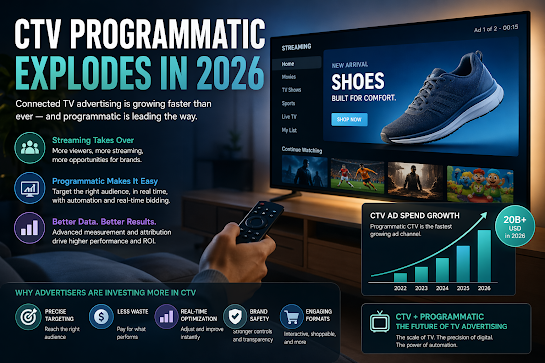
    Connected TV (CTV) has shed its “emerging channel” label. In 2026, it is the undisputed heavyweight of digital advertising, fueled by the total convergence of streaming scale and AI-driven precision.

    🚀 Why the Explosion is Peaks in 2026

    The shift is no longer a “trend”—it’s a completed migration.

    1. The “Tipping Point” of Viewership
      • Streaming Surpasses Linear: For the first time, streaming accounts for over 45% of all TV viewing, officially overtaking broadcast and cable combined.
      • The Rise of FAST: Free Ad-Supported TV (Pluto, Tubi, Samsung TV Plus) has become the new “basic cable,” offering massive reach for programmatic buyers.
    2. Agentic AI Integration
      • In 2026, we’ve moved past simple automation to Agentic AI. AI agents now manage real-time bidding, “attention-adjusted” pricing, and creative optimization without manual intervention.
    3. Retail Media & First-Party Data
      • With the death of the cookie, CTV has become the hero of First-Party Data. Brands now link retail purchase data (e.g., Walmart, Amazon) directly to TV impressions to prove exactly who bought a product after seeing an ad.

    📈 From Branding to Performance

    Traditional TV was a “reach” play. 2026 CTV is a “results” play.

    FeatureTraditional TV (Linear)Programmatic CTV (2026)
    TargetingBroad Demographics (Age/Gender)Household-level (Interests/Buying Habits)
    BuyingManual IOs & UpfrontsReal-Time Bidding (RTB)
    OptimizationStatic (Fixed 30-sec spots)Dynamic (AI-adjusted creative)
    MeasurementGRPs & EstimatesDirect Attribution (Web visits/Sales)

    🎨 New “Active” Ad Formats

    Viewers are no longer passive. The TV screen is now an interactive storefront:

    • Pause Ads: High-impact, non-intrusive ads that appear when content is paused—now rated the most effective CTV format.
    • Shoppable Overlays: AI-powered “click-to-cart” features that allow viewers to buy products via their remote or synced mobile device.
    • Home Screen Mastery: The Smart TV OS (Roku, Fire TV) is the new “Prime Time,” with ads appearing on the home screen before a user even picks a show.

    ⚠️ The Remaining Hurdles

    Despite the boom, the industry is still navigating:

    • Measurement Fragmentation: While tracking is better, “standardization” across Netflix, Disney+, and YouTube remains a work in progress.
    • The Ad Load Balance: As platforms push for revenue, “ad fatigue” is a growing risk. Quality and relevance are now more important than frequency.
    • Identity Resolution: Moving away from IP addresses toward more secure, privacy-compliant “Alternative IDs.”

    🔮 The Bottom Line

    In 2026, TV is no longer just a branding channel—it is a performance engine. The brands winning today are those that treat CTV like a giant, high-definition version of search or social: data-driven, automated, and hyper-personalized. By combining the emotional power of the “Big Screen” with the surgical precision of AI, programmatic CTV has become the most essential line item in the modern marketing budget.

  • The Shift from SEO to GEO (Generative Engine Optimization)

    The Shift from SEO to GEO (Generative Engine Optimization)

    The Shift from SEO to GEO (Generative Engine Optimization)

    For more than two decades, Search Engine Optimization (SEO) defined digital visibility. The objective was clear: rank on the first page and capture clicks from the familiar “ten blue links.”

    That era is fading.

    As we move deeper into 2026, a fundamental shift is underway—one that’s redefining how users discover information and how brands earn attention. The focus is no longer just on search engines. It’s on Generative Engine Optimization (GEO).

    With AI systems like ChatGPT, Gemini, and Claude becoming the primary interface for information discovery, the battleground has moved from search result pages to AI-generated answers, summaries, and citations.


    What is GEO?

    Generative Engine Optimization (GEO) is the practice of structuring and positioning content so it can be understood, synthesized, and cited by large language models (LLMs).

    Where SEO optimizes for ranking algorithms, GEO optimizes for response engines.

    It’s not about being one of ten links—it’s about being the source behind the answer.


    The Core Pillars of GEO

    1. Citation Authority
    Your goal is to become the source AI systems trust and reference. If your content is consistently cited, your brand becomes part of the answer itself.

    2. Semantic Depth
    Keywords are no longer enough. GEO prioritizes topic completeness—content that fully explains a subject through structured, interconnected ideas that AI can easily interpret.

    3. Information Density
    AI favors clarity and efficiency. High-value, fact-rich, and concise content outperforms long, unfocused writing. Every sentence should earn its place.


    Why This Shift Is Happening Now

    The Rise of Zero-Click Behavior
    Users increasingly get answers directly from AI summaries, skipping traditional search results entirely. The click is no longer guaranteed.

    Volatility in Organic Traffic
    The classic search landscape is becoming unstable. AI-generated overviews now dominate above-the-fold space, pushing traditional listings further down and reducing CTR.

    The Evolution of Search Behavior
    Search is no longer fragmented—it’s conversational. Users ask layered, intent-rich questions, and expect precise, contextual answers. GEO ensures your content is what AI selects in these moments.

    A Massive Opportunity Gap
    A relatively small portion of AI citations currently comes from major publishers. This opens the door for niche experts, independent creators, and specialized brands to establish authority—if they produce structured, high-quality information.


    Strategic Priorities for Marketers

    To stay competitive, the goal must shift from ranking pages to powering answers.

    1. Prioritize Structure Over Style
    Clear formatting wins. Use headings, bullet points, and schema markup to make your content easy for AI to parse and extract. If your key insights are easy to identify, they’re more likely to be cited.

    2. Create Citation-Ready Content
    Original insights are your strongest asset. Proprietary data, research, case studies, and expert perspectives dramatically increase your chances of being referenced by AI systems.

    3. Expand Your Brand Footprint
    GEO extends beyond your website. Mentions across forums, communities, and reputable publications reinforce credibility. The broader your presence, the stronger your “trust signal” to AI models.


    The Future: Beyond the Click

    In the GEO era, success isn’t defined solely by traffic—it’s defined by influence within the answer layer.

    Even without a click, being cited as the trusted source builds authority, recall, and long-term brand equity in ways traditional metrics can’t fully capture.


    Final Thought

    The transition from SEO to GEO isn’t just tactical—it’s philosophical.

    It’s no longer enough to be discoverable.